

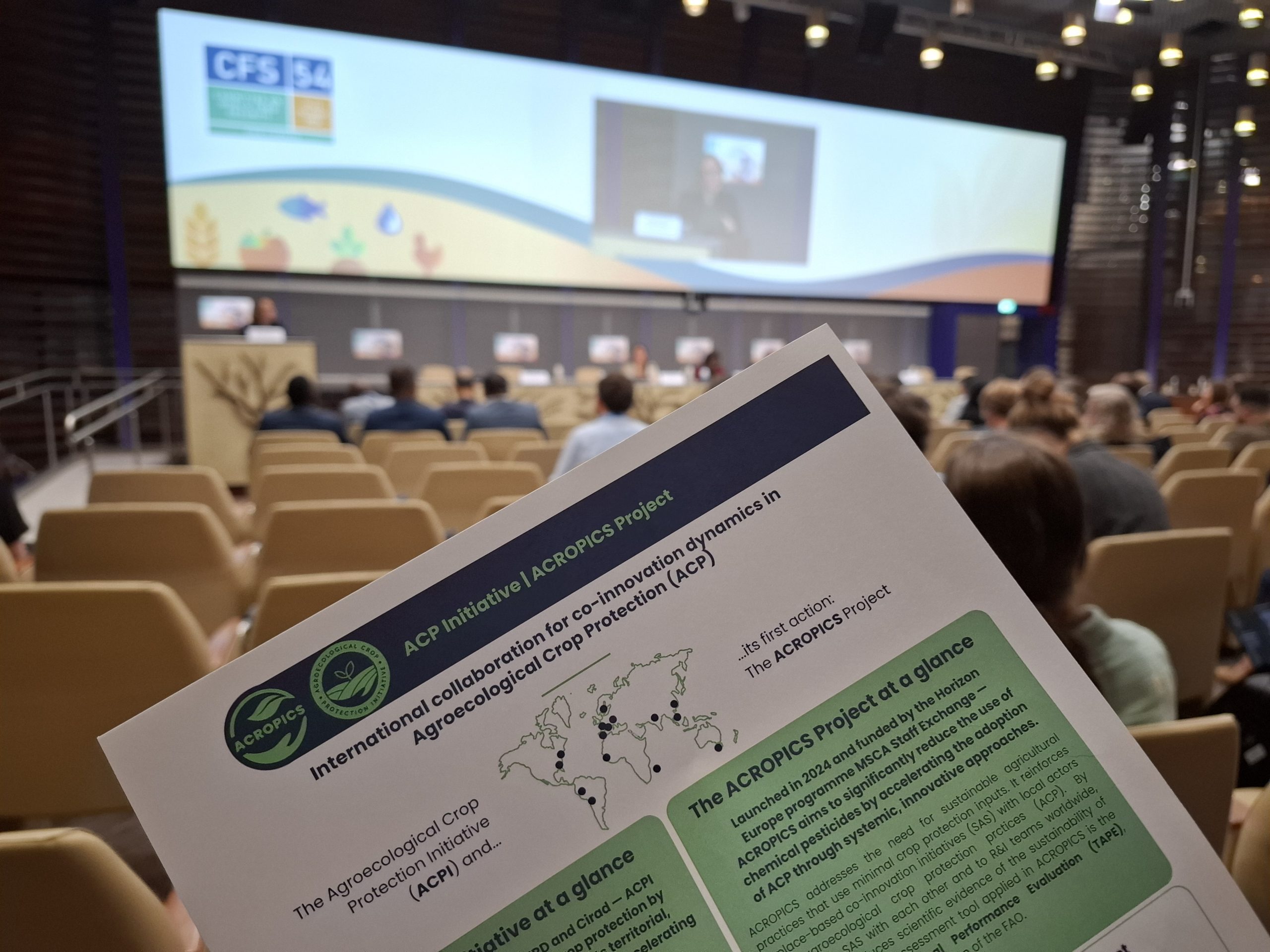
20 October 2026 | FAO Headquarters, Rome, Italy
How can we generate robust evidence on agroecology while better understanding the processes through which agricultural systems transition towards greater sustainability? This question was explored during the side event “Bridging Data Gaps to Scale Agroecology: From Local Knowledge to National Policy Through Evidence and Digital Innovation”, held on 20 October 2026 at the headquarters of the Food and Agriculture Organization of the United Nations (FAO), in the context of the 54th session of the Committee on World Food Security (CFS54).
Bringing together researchers, international organisations, funding partners, farmer organisations and public institutions, the event explored how assessment tools, research and digital innovation can strengthen the evidence available to inform agroecological policies and support transitions across different contexts.
ACROPICS: understanding both sustainability performance and transition processes
During the event, Allison Loconto (INRAE) presented ongoing research and progress from ACROPICS – Agroecological Crop Protection: towards international co-innovation dynamics and evidence of sustainability, the first research project developed under the Agroecological Crop Protection Initiative (ACPI).
Her presentation highlighted the project’s contribution to the assessment and monitoring of agroecological transitions, drawing on the FAO Tool for Agroecology Performance Evaluation (TAPE) and complementary participatory approaches.
Within ACROPICS, a TAPE baseline assessment has been conducted across 539 farms in eight Sustainable Agroecological Systems (SAS). This provides an important basis for examining the sustainability performance of farms engaged in different agroecological contexts.
However, understanding agroecological transitions requires looking beyond performance indicators alone. It also means examining how change takes place, which actors and relationships contribute to it, and which social and institutional conditions enable or constrain it.
ACROPICS therefore combines TAPE assessments with participatory, process-oriented research on transition pathways across multiple countries. This complementary approach makes it possible to consider current sustainability performance alongside the collective dynamics and institutional mechanisms shaping agroecological change.
Connecting principles, pathways and performances
A central element of the presentation was a framework connecting three complementary dimensions of agroecological transitions:
- Principles: the values and principles that orient agroecological transitions.
- Pathways: the processes and trajectories through which change unfolds in different contexts.
- Performances: the sustainability outcomes that can be assessed and used to inform learning and adaptation.
Connecting these dimensions helps move towards a more comprehensive understanding of agroecological transitions. It allows research to consider not only whether agricultural systems are achieving more sustainable outcomes, but also how these outcomes emerge and what contributes to them.
In this respect, the combination of TAPE and participatory approaches developed within ACROPICS contributes to broader discussions on how to monitor agroecological transitions in ways that account for both measurable outcomes and the processes underlying change.
Contributing to international discussions on agroecological evidence
The side event highlighted the growing importance of reliable, comparable and context-sensitive evidence to support the development of agroecology. Presentations addressed methodological developments in TAPE, preliminary findings from cross-country assessments, digital tools for data collection and analysis, and national initiatives seeking to integrate agroecological indicators into monitoring and policy processes.
ACROPICS’ contribution brought an additional perspective to these discussions by highlighting the importance of understanding transitions as ongoing processes, shaped by interactions between farmers, researchers, institutions and other actors.
By connecting farm-level sustainability assessments with research on collective action and transition dynamics, the project aims to contribute to a richer understanding of how agroecological systems evolve and how these transitions can be supported in different territorial contexts.
Participation in CFS54 provided an opportunity to share the project’s progress with an international audience and to connect ACROPICS’ research with wider efforts to strengthen the evidence base for agroecology and inform policy development.
Watch the side event replay:
Watch the recording



0 Comments